When you plan a solar installation for your home or your business you will be asked whether your property is single phase or three phase. Many people are not sure which one they have. Your supply type affects the size of your inverter, the type of battery system you can install and how the system will operate day to day.
This guide explains everything clearly so you can check your own supply in a few seconds.
Most homes in the UK use single phase electricity. Many small businesses do as well especially those in converted houses, small retail units, small offices and light industrial units.
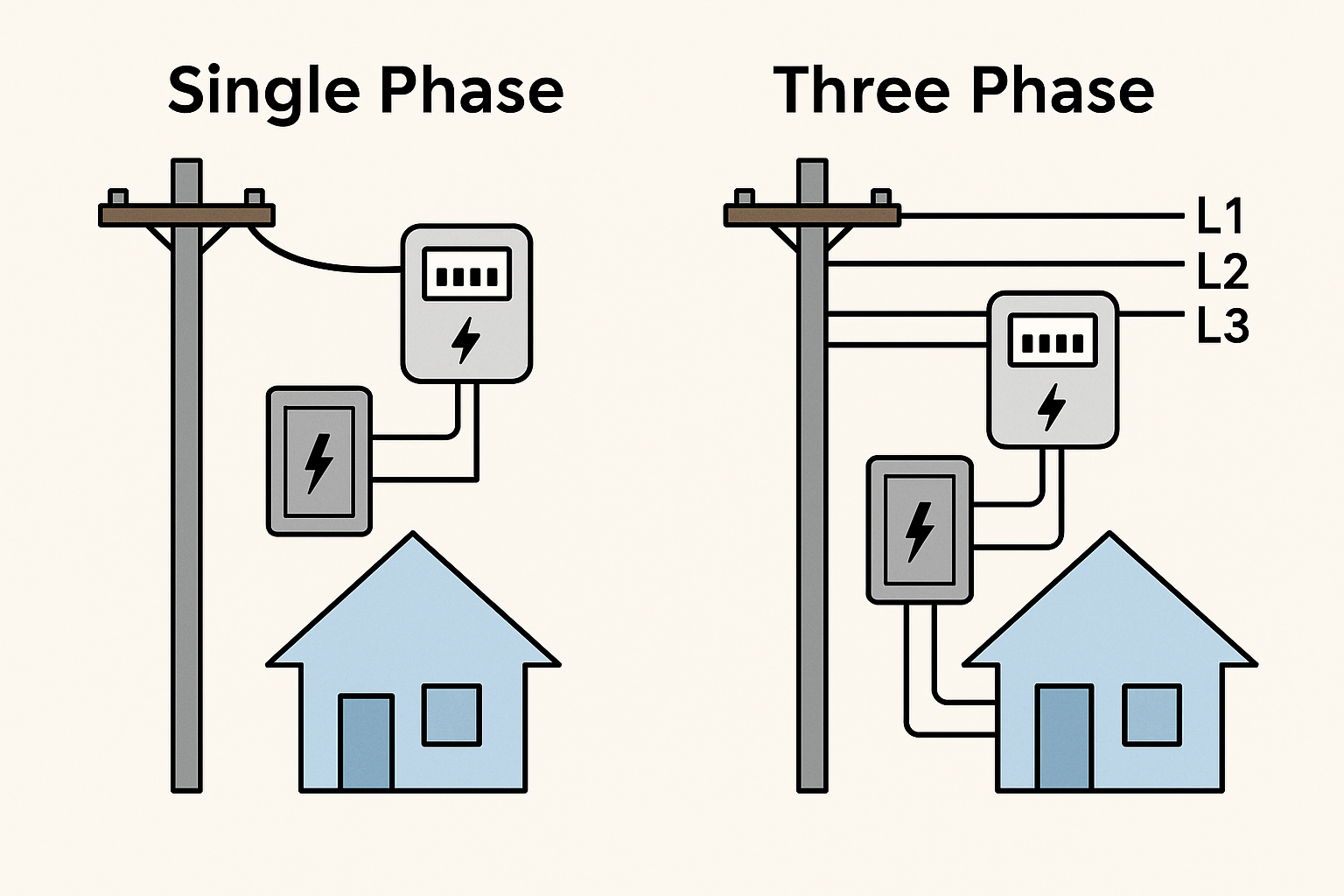
Single phase supply means your property has one main incoming line. You can think of this as one strong lane of electricity. It is designed for everyday loads such as lighting, sockets, appliances, computers and standard commercial equipment.
If you have single phase supply your solar installer will design a system around a single phase inverter. This keeps everything balanced and compliant with UK electrical standards.
Three phase supply means your property has three incoming electrical lines. This is common in larger homes and in commercial buildings such as warehouses, workshops, factories, farms, hotels and buildings with heavy machinery or lifts.
Three phase supply provides three balanced lanes of electricity. This allows your property to support higher combined loads such as large refrigeration, machines with heavy starting loads, high output EV chargers and large heat pumps.
If you have three phase supply your system will normally use a three phase inverter. This spreads the incoming solar power evenly across all phases.
Your electricity supply affects the size of inverter you can install, the maximum solar output allowed under DNO rules, how your battery charges and discharges, how backup power behaves during an outage and whether your system needs phase balancing.
You do not need to know the technical details. You only need to know whether your property has one phase or three phases so the design can be matched correctly.
This is the simplest way. Single phase will show one main fuse. Three phase will show three main fuses often labelled L1, L2 and L3.
Single phase has one wide switch. Three phase has a wider switch with three linked poles.
Many smart meters display either 1 phase or 3 phase in the menu.
Your Distribution Network Operator can confirm it in under a minute. You simply ask whether your property is single phase or three phase.
Both supply types work perfectly as long as your system is designed for the supply you have. Single phase supply uses a single phase inverter and three phase supply uses a three phase inverter. Both can run solar panels, batteries, EV chargers and full backup with the correct design.