
Solar Battery Storage Designed Around How Your Home Uses Electricity
A home battery is often introduced by talking about capacity, equipment brands and price.
But none of those details tells us what you need the stored electricity to achieve.
Your electricity use, solar generation, tariff, electrical arrangements and future plans all influence which battery arrangement may be appropriate.
The purpose of the battery should determine the system, not the other way around.
No obligation. No sales teams. Built around your electricity use and future plans.
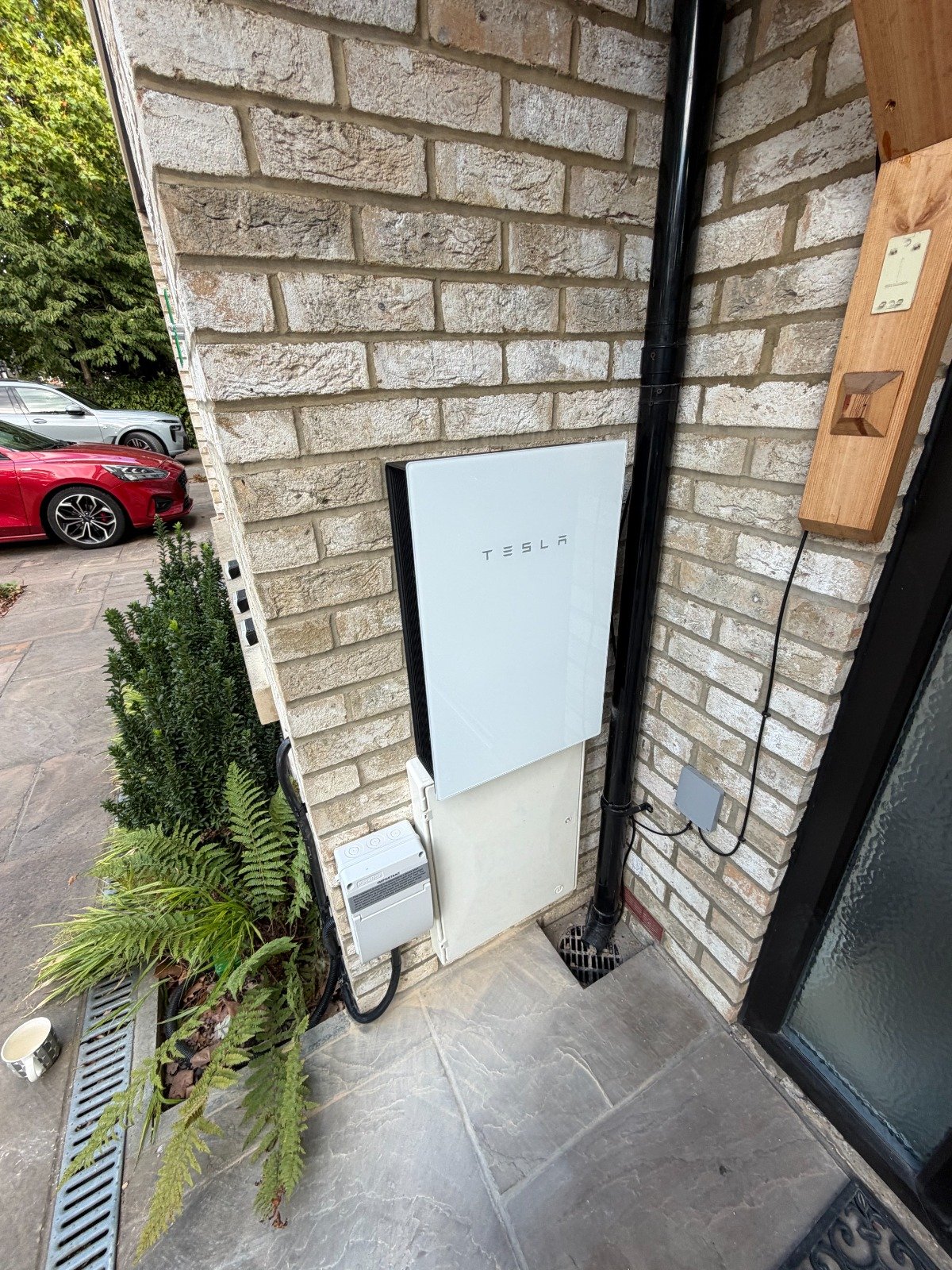
Home Battery Storage In Brief
A home battery moves electricity from one time to another. It does not create additional electricity.
The amount it can store matters, but so does how quickly it can charge and supply the home.
A larger battery is not automatically a more useful battery.
Its value depends on where the electricity comes from, when the household needs it and what that electricity would otherwise cost or earn through export.
Backup power is a separate design consideration. A battery does not necessarily keep the home operating during a power cut.
The right starting point is not “Which battery should I buy?” It is “What do I need the stored electricity to achieve?”
What Do You Need YOUR Battery To Do?
| Main Objective | What The Battery Does | What Must Be Established |
|---|---|---|
| Store Surplus Solar | Charges from electricity the panels generate but the home does not immediately use. | Whether the home regularly produces enough surplus and needs that electricity later. |
| Use Off-Peak Electricity | Charges from the grid during lower-priced tariff periods and discharges when electricity costs more. | Whether the tariff difference remains worthwhile after charging losses and household demand are considered. |
| Combine Solar And Tariff Charging | Uses available solar generation alongside controlled grid charging when appropriate. | How the charging strategy should change with consumption, tariffs and the seasons. |
| Provide Power During An Outage | Supplies agreed essential circuits or, where properly designed, a larger part of the home. | Backup-capable equipment, changeover arrangements, earthing, peak demand and which circuits must remain powered. |
One battery can sometimes perform more than one job, but the system must be designed around every job it is expected to perform.
CAPACITY AND POWER
Capacity And Power Are Not The Same Thing
Battery capacity is normally measured in kilowatt-hours, or kWh. It describes how much usable electricity the battery can store.
Battery power is measured in kilowatts, or kW. It describes how quickly the battery can charge and how much electrical demand it can support at a particular moment.
A battery can have plenty of stored energy without being able to supply every appliance at the same time.
Think of a large multi-storey car park with one narrow exit.
It may hold hundreds of vehicles, but when everybody decides to leave together, the size of the car park does not make the queue move any faster.
The number of parking spaces is rather like battery capacity. It tells us how much can be held.
The width and number of exits are more like battery power. They determine how quickly that stored capacity can be delivered.
This distinction becomes important when several high-demand appliances operate together. An oven, kettle, heat pump or EV charger can create a much larger short-term demand than lighting, refrigeration and ordinary background consumption.
The home may use electricity from the battery and the grid at the same time if demand exceeds what the battery or inverter can supply. During a power cut, the available backup output may be limited further by the equipment and electrical arrangement.
Enough energy to last for several hours is not the same as enough power to run everything simultaneously.
Charging power matters too.
A battery may have enough capacity to absorb the expected solar surplus, but if it cannot charge quickly enough during the available generation period, some electricity may still be exported. The same principle applies when charging from a short off-peak tariff window.
This is why battery assessment should consider:
- Usable storage capacity
- Maximum charging power
- Maximum discharge power
- Inverter limitations
- Normal household demand
- Short periods of higher demand
- The appliances expected to operate during backup
- The time available for solar or tariff charging
Battery capacity tells us how much electricity may be available. Battery power helps determine how usefully that electricity can be delivered.
Both need to suit the job the homeowner expects the battery to perform.
SYSTEM ARRANGEMENT
How Will The Battery Connect To The Home?
A home battery does not connect to every solar system in the same way.
The appropriate arrangement depends partly on whether the battery is being installed with new solar panels or added to a system that is already operating.
A battery can be suitable for the household and still be incompatible with the proposed inverter arrangement.
Battery Storage With A New Solar Installation
When solar panels and battery storage are installed together, a hybrid inverter may be used to manage both.
Solar electricity can supply the home first, charge the battery when surplus generation is available and export electricity that is not used or stored.
This can provide a coordinated arrangement using one principal inverter, but the equipment must still be selected around the panel layout, battery compatibility, charging requirements and future plans.
Adding A Battery To Existing Solar Panels
An existing solar system does not necessarily need to be replaced before battery storage can be added.
An AC-coupled battery has its own inverter and can operate alongside the existing solar inverter. This can provide a practical retrofit solution, particularly when the original solar equipment is working properly and remains suitable for continued use.
However, the existing installation must be understood first.
That assessment should consider:
- The make, model and age of the existing inverter
- The original panel arrangement and system capacity
- Available monitoring and generation records
- Existing warranties
- Consumer-unit and electrical arrangements
- Metering and control equipment
- Suitable battery and inverter locations
- Cable routes
- Export limitations or permissions
- Whether backup power is expected
An AC-coupled arrangement may involve additional conversion stages because solar electricity is converted to AC before being converted again for battery storage. That does not automatically make it the wrong choice. The practical benefits of retaining suitable existing equipment may outweigh the conversion difference.
The most efficient-looking arrangement on paper is not always the most sensible arrangement for the property.
Equally, replacing working equipment simply to create a tidier specification may add cost without delivering a worthwhile benefit.
The decision should be based on compatibility, performance, warranties, installation requirements and what the homeowner wants the complete system to achieve.
New solar and battery storage can be designed together. Existing solar and a new battery must be designed to work together.
POWER CUTS AND BACKUP
Will A Home Battery Keep The Lights On During A Power Cut?
Not necessarily.
A standard grid-connected solar and battery system may shut down when the electricity supply fails. This prevents electricity from being sent into the grid while engineers may be working on it.
A charged battery does not automatically mean the home has backup power.
The electricity may be waiting inside the battery, but it still needs a safe route into the home when the grid is unavailable.
Backup operation requires compatible equipment and an electrical arrangement designed to separate the home, or selected circuits, safely from the grid.
There are two broad approaches.
Essential-Circuit Backup
Selected circuits can be supplied during an outage.
These might include lighting, refrigeration, broadband, heating controls and particular sockets. Restricting backup to genuinely important circuits can reduce demand and help the stored electricity last longer.
Larger Or Whole-Home Backup
A suitably designed system may support a larger part of the property.
However, whole-home backup does not mean that every appliance can be operated without limitation. The battery, inverter and backup equipment must be capable of supporting the demand placed on them.
An oven, electric shower, heat pump, immersion heater or EV charger could use a substantial amount of the available power and stored energy.
The battery may contain enough electricity for several hours while still being unable to supply every appliance simultaneously.
A backup assessment should establish:
- Which circuits need to remain available
- The normal and maximum demand from those circuits
- The battery’s available state of charge when an outage begins
- The inverter’s backup-output limit
- How the property will be isolated from the grid
- The required changeover and earthing arrangements
- Whether solar panels can continue charging the battery during the outage
- How long the homeowner reasonably expects backup to last
Solar panels do not necessarily continue operating during a power cut. Continued solar generation depends on the inverter, battery and backup system being designed to operate safely while disconnected from the grid.
Backup settings may also reserve part of the battery’s capacity for emergencies. Keeping a larger reserve can provide reassurance, but it leaves less stored electricity available for everyday bill reduction.
Backup is not simply a battery feature. It is a function of the complete electrical system.
The right question is therefore not only, “Can this battery provide backup?”
It is:
“What do I need to keep running, and for how long?”

BATTERY LOCATION AND SAFETY
Where Can A Home Battery Be Installed?
A home battery needs more than an empty piece of wall.
Its position affects fire safety, operating temperature, cable routes, maintenance access and the practicality of the entire installation.
The most convenient available space is not automatically the correct place for a battery.
Domestic batteries should not be installed in voids, roof spaces or lofts. Current battery fire-safety standards exclude these locations and the updated UK Wiring Regulations reinforce the requirements governing where stationary battery systems may be installed.
This means the proposed location should be assessed before the equipment is selected.
The assessment should consider:
- The manufacturer’s installation instructions and required clearances
- Current electrical and fire-safety requirements
- Ventilation and the temperatures the battery may experience
- Exposure to rain, direct sunlight, flooding or accidental damage
- The strength and construction of the supporting wall or floor
- Safe access for inspection, isolation and future maintenance
- The route between the battery, inverter, consumer unit and electricity meter
- Whether the position could obstruct an entrance, exit or escape route
A garage, utility room, outbuilding or outside wall may provide a suitable alternative, but none should be accepted without assessment.
Garages may require protection from vehicles and stored combustible materials. Internal positions require consideration of fire separation and escape routes. Outdoor equipment must be appropriately rated and positioned with regard to doors, windows, ventilation openings and exposure to the weather.
A good installation should be safe, accessible and neatly arranged. It should also allow the homeowner and an attending engineer to identify and isolate the equipment when necessary.
Battery location should form part of the system design from the beginning, not be decided after the equipment has been purchased.
Where the battery can be installed may influence which battery can be installed.
CHARGING STRATEGY
Where Will The Battery’s Electricity Come From?
A battery can be charged using surplus solar generation, lower-priced grid electricity or a combination of both.
The most appropriate strategy depends on the solar system, household consumption, electricity tariff and what the battery is expected to achieve.
A battery does not reduce electricity costs simply because it has been installed. Its value depends on when it charges, what that electricity costs and when it is used.
It is rather like driving several miles to a petrol station because the fuel is cheaper there.
The price displayed on the sign may be lower, but the true saving depends on how much fuel you buy and how much time and fuel the extra journey consumes.
Charging a battery at a cheaper rate works in much the same way. The charging price matters, but so do conversion losses and the price of the electricity that the stored energy later replaces.
A cheaper charging rate only creates a worthwhile saving when the complete journey of that electricity has been considered.
During brighter months, surplus solar electricity may charge the battery after the immediate needs of the home have been met. That stored electricity can then be used later in the day when the panels are producing less.
During winter, there may be considerably less surplus solar available. A compatible time-of-use tariff can sometimes allow the battery to charge from the grid during a lower-priced period and supply the home when electricity is more expensive.
Several factors need to be considered:
- The difference between the charging and daytime electricity rates
- How much solar electricity would otherwise be exported
- The payment available for exported electricity
- Battery charging and discharging losses
- The battery’s usable capacity and power
- Household electricity consumption during higher-priced periods
- Tariff conditions and whether prices or charging periods may change
- Whether some capacity must be reserved for backup power
Using stored solar electricity is not automatically better than exporting it. The comparison depends on what the exported electricity earns and what replacement electricity would cost later.
No battery returns every unit of electricity placed into it. Some energy is lost during charging, storage and conversion, so calculations should be based on usable electricity rather than assuming perfect efficiency.
Summer and winter may require different charging strategies. A battery setting that works well in June may be poorly suited to December.
The system should therefore be monitored and its operating schedule reviewed as generation, consumption and tariffs change.
A battery is most useful when its charging strategy reflects the household’s real electricity pattern, not a generic timetable copied from somebody else’s system.
BEFORE A BATTERY IS SPECIFIED
What Should A Home Battery Assessment Establish?
A battery assessment should begin with evidence about the home, not a preferred equipment brand or a preselected package.
Electricity bills provide a starting point, but annual consumption alone does not reveal when the electricity is being used.
Two homes can consume the same amount of electricity over a year and require very different battery arrangements.
Where information is available, the assessment may examine:
- Household electricity consumption and the times it occurs
- Smart-meter or half-hourly usage data
- Existing solar generation and export records
- Seasonal differences in generation and consumption
- Current and possible future electricity tariffs
- The existing inverter and its compatibility with battery storage
- The electrical supply, consumer unit and metering arrangements
- Suitable battery and inverter locations
- Cable routes and safe isolation requirements
- Essential appliances if backup power is required
- Planned changes such as an electric vehicle, heat pump or home extension
The assessment should also establish whether the battery is intended primarily to capture surplus solar, shift lower-priced grid electricity, provide backup or combine several functions.
Without a defined purpose, it is impossible to judge whether a proposed battery is appropriately sized.
A larger battery may remain partly unused. A smaller battery may be emptied too early. A battery with sufficient capacity may still lack the power needed for the appliances the homeowner expects it to support.
The proposed design should therefore explain not only which battery is recommended, but why its usable capacity, power, connection method and operating strategy suit the property.
The recommendation should be the result of the assessment, not the starting point of it.
A well-designed battery system is one whose purpose, size and controls can all be explained clearly before installation begins.
AFTER INSTALLATION
How Will You Know The Battery Is Working Properly?
A home battery should not become an unexplained box on the wall once the installation is complete.
During commissioning, the installer should confirm that the battery charges, discharges and communicates correctly with the inverter, meter and monitoring system.
Seeing electricity stored in the battery does not, by itself, prove that the complete system is operating as intended.
The homeowner should be shown:
- How to use the monitoring application or online portal
- How to recognise when the battery is charging or supplying the home
- How to view its state of charge
- Which operating mode has been selected
- How any charging schedules or reserve settings work
- What the warning messages and system alerts mean
- Who to contact if the system stops operating normally
Monitoring can help reveal unexpected grid charging, missed charging periods, unusually low discharge, communication problems or settings that no longer suit the household.
Monitoring data becomes useful when somebody understands what normal performance should look like.
Tariffs, household routines and electricity use can change after installation. An electric vehicle, heat pump or change in working hours may alter when energy is required. The battery’s operating schedule may therefore need reviewing rather than being left permanently on its original settings.
Equipment warranties should also be explained clearly, including any registration requirements, operating conditions and differences between product, workmanship and performance warranties.
A monitoring application provides information. It does not replace proper commissioning, documentation or technical support.
A well-completed installation should leave the homeowner with the relevant certificates, warranty information, system settings and a clear route to aftercare.
The installation is not properly finished until the homeowner understands what the system is doing.
THE FINAL DECISION
Does Battery Storage Make Sense For Every Home?
No. A battery can be extremely useful, but it is not automatically the right investment for every household.
Its suitability depends on what the homeowner wants it to achieve and whether the property, electricity use and financial circumstances support that objective.
A battery may be worth considering when:
- Surplus solar generation regularly leaves the home
- A suitable time-of-use tariff creates a worthwhile charging opportunity
- A significant amount of electricity is required outside solar-generating hours
- Greater control over when grid electricity is purchased is important
- Properly designed backup power would provide a meaningful benefit
- Future changes are likely to increase household electricity consumption
It may be less compelling when electricity consumption is already very low, little energy is available to store, tariff differences are small or the proposed installation costs cannot be justified by the intended result.
The question is not whether home batteries work. It is whether a battery will perform a useful and proportionate job in your particular home.
That conclusion cannot be reached from battery capacity, an estimated payback figure or a list of product features alone.
It requires the proposed battery to be considered as part of the complete electrical arrangement, including solar generation, tariffs, household demand, installation location and future plans.
The right outcome may be a battery of a particular size, a system designed for later expansion or a decision that battery storage is not presently necessary.
An engineer-led assessment should be capable of reaching any of those conclusions.
Start With What You Need The Battery To Achieve
Tell us about your electricity use, existing solar system, tariff, backup requirements and future plans.
We will help establish whether battery storage is appropriate and what the complete system would need to accomplish before particular equipment is recommended.
No predetermined package. No sales team. No obligation to proceed.
Engineering, installation and MCS certification are provided by Array Electrics Ltd.