FiT vs SEG 2025: What Homeowners Should Know
The Feed-in Tariff closed years ago but its replacement, the Smart Export Guarantee (SEG), has matured fast. This guide explains how they differ, what FiT owners should check, and how new SEG users can maximise export income in 2025.
From FiT to SEG: the policy shift explained
The Feed-in Tariff guaranteed a fixed payment for every unit of solar electricity generated, plus an extra rate for exported energy. It was simple, generous, and locked in for up to twenty years. By contrast, the Smart Export Guarantee rewards only exported power, with rates set by suppliers and no fixed government subsidy.
In short, FiT was a state backed income. SEG is a market based offer. The government no longer sets the price. Energy suppliers set it. The result is a more dynamic export environment, especially for homes with batteries and flexible control.
Who still has the Feed-in Tariff
Most FiT participants installed before 2019 and continue receiving fixed payments. These systems are unaffected by SEG unless the homeowner decides to switch. When a FiT contract ends there is no automatic extension, new export earnings would fall under SEG rules.
Some FiT customers choose to leave their export component and join SEG for potentially higher rates, especially if they have added battery storage or upgraded metering. This can be worthwhile but it requires careful coordination with your FiT administrator and your energy supplier.
How the Smart Export Guarantee works
Under SEG suppliers set their own export rates. These typically range from 4 pence to over 20 pence per kWh, depending on whether the tariff is fixed or dynamic. Payments are made for measured export via a smart meter, usually on a monthly or quarterly schedule.
- Fixed SEG: simple, predictable rate for each exported kWh.
- Dynamic SEG: price changes hourly or half hourly, linked to market demand.
- Premium tiers: often available to customers who also buy electricity from the same supplier.
The best results usually come from pairing dynamic SEG with a controllable battery or inverter system that can target peak export windows automatically.
Should existing FiT users consider switching
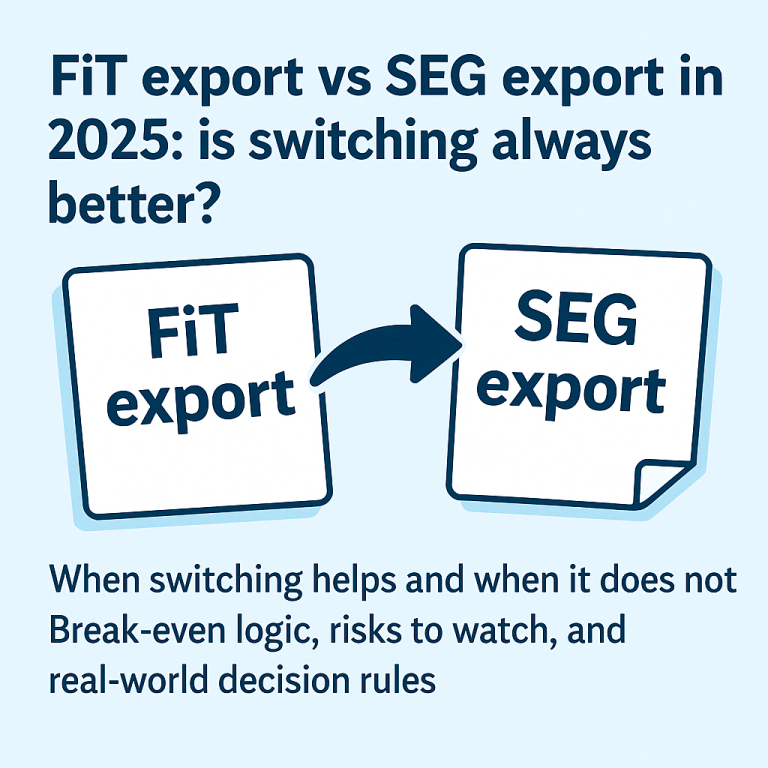
Switching from FiT export to SEG can make sense for some households but not for all. FiT generation payments are unaffected and continue for the full term, but if you voluntarily end your export payments you cannot rejoin later.
The decision depends on your generation size, your export percentage, and your access to dynamic rates. For smaller systems without batteries, FiT stability may still be more valuable. For larger, controllable systems, SEG flexibility could outperform it in high demand months.
Example: a 4 kW FiT system exporting 50% of generation at 5.24 pence per kWh might earn about £70 a year in export payments. A dynamic SEG tariff averaging 15 pence per kWh for the same export would roughly triple that value, but only if smart metering and timing align.
Planning ahead for 2025 and beyond
The SEG landscape is evolving. More suppliers now offer dynamic rates linked to the wholesale market, and battery control systems are becoming smarter at scheduling exports. Homes that can shift energy into evening peaks stand to gain the most.
Whether you are on FiT or on SEG the principle is the same. Control when you export and treat your solar system as an asset you can actively manage, not just passively generate from.
Want tailored advice on FiT and SEG options
Call 0118 338 5065
or
email info@solarpanelinstallers.co.uk