SOLAR MICROINVERTERS: DOES EVERY PANEL NEED ITS OWN?
A clear comparison of string inverters, power optimisers and microinverters.
Does Every Solar Panel Need Its Own Inverter?
Microinverters solve a genuine design problem. But that does not mean every solar installation needs them.
Every solar panel produces direct current electricity, known as DC. Your home and the electricity network use alternating current, or AC. An inverter performs the essential job of converting one into the other.
The decision is where that conversion should happen.
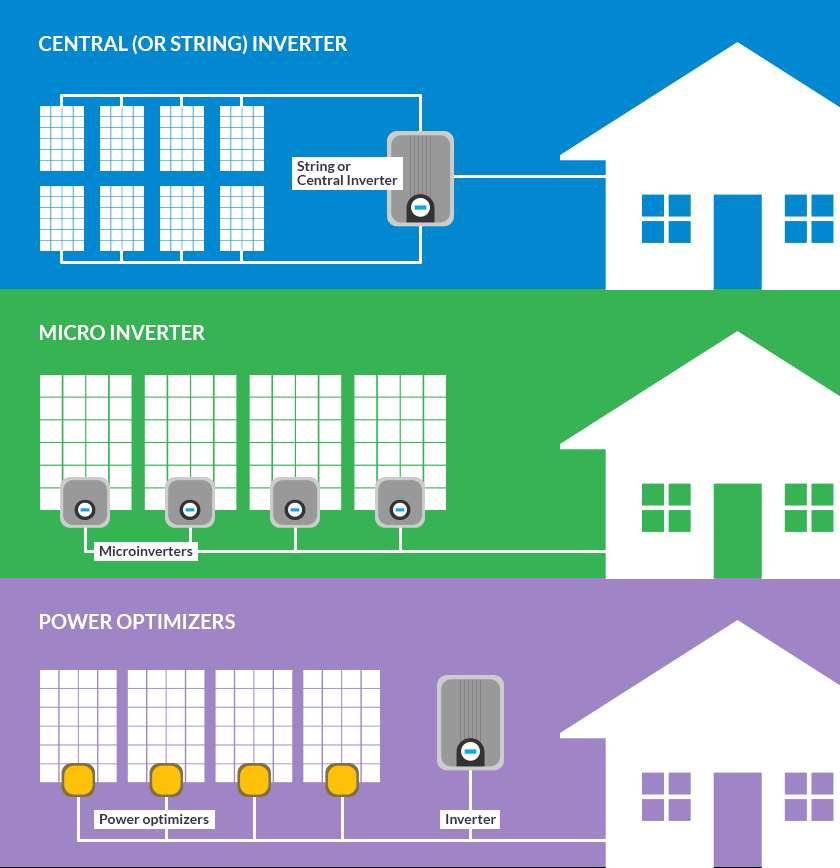
A conventional solar system usually connects several panels to one central string inverter. A microinverter system places a small inverter beneath each panel, allowing every panel to convert its own electricity independently. Power optimisers sit between those two approaches: they manage individual panels but still send DC electricity to a central inverter.
Panel-level control can be valuable on roofs with different orientations, irregular layouts or periods of shade. It can also provide more detailed monitoring and make certain system extensions easier.
However, more equipment does not automatically mean a better-designed system.
The right question is not, “Are microinverters better?” It is, “What does this particular roof and household actually require?”
What Does a Solar Inverter Actually Do?
Solar panels produce direct current electricity, usually shortened to DC. Your home, appliances and the electricity network operate using alternating current, known as AC.
The inverter converts the electricity produced on the roof into electricity that can be used within the home or exported to the grid.
You could think of it as an electrical interpreter. The solar panels and your home speak different languages, and the inverter allows them to understand one another.
An inverter also monitors and manages the solar array. Depending on the system, it may track the performance of the complete array, separate strings of panels or every individual panel.
This is where the design choices begin.
A conventional string inverter manages groups of panels from one central position. A system using power optimisers adds control at individual-panel level while retaining the central inverter. A microinverter system performs the DC-to-AC conversion separately beneath each panel.
All three approaches can produce an effective solar installation. The correct choice depends on the roof, shading, layout, monitoring requirements, future plans and the value gained from the additional equipment.
How Does a String Inverter Work?
In a conventional solar installation, panels are connected together in groups known as strings. The DC electricity produced by those panels travels to one central inverter, which converts it into AC electricity for the home.
The inverter is normally fitted somewhere accessible, such as a garage, utility area or suitable external wall. This makes monitoring, inspection and replacement relatively straightforward.
A string inverter is like one well-designed kitchen serving the entire restaurant. There is one central place where the important work happens, rather than placing a separate kitchen at every table.
This approach is established, comparatively simple and often cost-effective. On a straightforward roof where the panels share a similar orientation and receive broadly similar sunlight, a properly designed string-inverter system may be entirely appropriate.
Shade needs a more careful explanation than it is sometimes given.
One shaded panel does not necessarily bring the whole solar array to a halt. Modern panels contain bypass diodes, and many string inverters have more than one maximum power point tracker, known as an MPPT. Good string design can therefore separate different roof orientations or operating conditions.
However, panels connected within the same string still influence one another. Persistent shade, uneven orientations or significant differences between panels can make panel-level control more useful.
A string inverter is not the inferior option. It is the simpler option, and simplicity can be a strength when the roof allows it.
A string inverter may suit:
- A simple, largely unshaded roof
- Panels facing the same or compatible directions
- Homeowners who prefer fewer rooftop electronic components
- Installations where straightforward access and replacement are priorities
Where Do Power Optimisers Fit?
A power optimiser is a small electronic device fitted beneath an individual solar panel. It manages that panel’s DC output before sending the electricity to a central string inverter, where the conversion to AC takes place.
This means every panel can be managed and monitored separately while the system retains one central conversion point.
If one panel experiences shade or operates differently from its neighbours, its optimiser can help prevent that difference from unnecessarily restricting the other panels. Panel-level monitoring can also make it easier to identify where an unexpected change in performance is occurring.
Power optimisers give each panel some independence without giving every panel its own complete inverter.
They can be particularly useful on roofs with multiple orientations, dormers, chimneys or shade that moves across the array during the day. They may also help where detailed panel-level monitoring is important to the homeowner.
However, an optimiser system is not simply a conventional string system with free additional benefits. It introduces an electronic device beneath every panel, adds cost and still relies on a compatible central inverter.
If that central inverter stops operating, the system stops converting solar electricity until it is repaired or replaced. Accessing a failed optimiser may also require a panel to be lifted.
Optimisers can solve genuine design problems, but they should be specified because the roof benefits from them, not because a quotation needs another impressive-looking component.
Power optimisers may suit:
- Roofs with different orientations or pitches
- Arrays affected by partial or moving shade
- Homeowners wanting panel-level monitoring
- Designs that benefit from individual-panel management while retaining a central inverter
How Do Solar Microinverters Work?
A microinverter is a compact inverter fitted beneath an individual solar panel. Instead of sending DC electricity from several panels to one central inverter, each microinverter converts its panel’s electricity into AC on the roof.
Every panel therefore has its own conversion and power-management equipment.
If one panel is shaded, dirty or operating differently, the other panels can continue working according to their own conditions. Monitoring can normally show the production of each panel separately, making unusual performance easier to locate.
If a string inverter is one central kitchen serving the restaurant, microinverters are smaller kitchens at every table. Each can work independently, but the restaurant now has considerably more kitchens to buy, monitor and occasionally access.
This independence can be valuable on complicated roofs, where panels face several directions or receive different amounts of sunlight. It can also make future expansion more flexible, provided compatible equipment remains available and the electrical design allows it.
Microinverters do not, however, manufacture sunlight.
A panel beneath heavy shade will still produce less electricity. A poor roof remains a poor roof, and detailed monitoring does not recover the generation that was never available.
Microinverters also place more electronic equipment on the roof. Although removing a single central inverter avoids one particular point of failure, replacing a unit beneath a panel may require roof access and temporary panel removal.
They also replace long strings of higher-voltage DC cabling with AC wiring from the roof array. That is a meaningful design difference, but it should not be described as “low-voltage AC”. It remains an electrical system that must be correctly designed, installed and protected.
Microinverters provide panel-level independence. Whether that independence is worth buying depends on what problem it solves.
Microinverters may suit:
- Complex roofs with several orientations or pitches
- Arrays experiencing different conditions across individual panels
- Homeowners who value detailed panel-level monitoring
- Systems where gradual future expansion forms part of the original design
- Projects where avoiding one central conversion point is a priority
When Does Panel-Level Control Genuinely Help?
Microinverters and power optimisers allow individual panels to operate with greater independence. That facility is valuable when panels experience meaningfully different conditions.
It is less valuable when every panel occupies one simple, unshaded roof and operates under broadly the same conditions.
Panel-level control should solve an identifiable design problem. It should not be added merely because more technology sounds more advanced.
Different Roof Orientations
A UK home may have panels divided between east-facing, south-facing and west-facing roof areas. Those groups receive their strongest sunlight at different times of day.
Some layouts can be managed effectively using separate inputs on a suitable string inverter. More complicated arrangements may benefit from individual-panel control.
The number of roof directions alone does not decide the technology. The designer must also consider the number of panels, string-voltage requirements, inverter inputs and expected generation from each roof area.
Partial or Moving Shade
Chimneys, trees, dormers and neighbouring buildings can cast shade that moves across an array during the day.
Panel-level control can reduce the electrical effect that an underperforming panel has on others. However, it cannot recover sunlight that does not reach the panel.
A microinverter can manage a shaded panel intelligently. It cannot persuade the chimney to move.
Persistent shade should therefore be assessed before the system is designed, not treated afterwards as a problem that electronics will automatically cure.
Panel-Level Monitoring
Microinverters and optimiser systems can normally report the performance of individual panels. This may help identify an unusual change without treating the entire array as one unit.
That information can be useful, but more data is not the same as more generation. Monitoring creates value when somebody notices, interprets and acts upon what it reveals.
Homeowners should also establish who can access the monitoring platform, what information they will see and whether any continuing account or communication service is required.
Future Expansion
Microinverters can make gradual expansion more flexible because additional panels do not necessarily need to match an existing string in the same way.
But expansion is never guaranteed simply because microinverters are fitted.
Available roof space, electrical capacity, export limitations, equipment compatibility and future product availability still matter. If expansion is genuinely anticipated, it should form part of the original system design.
Panel-level control becomes worthwhile when it provides a clear answer to a relevant roof, monitoring or expansion requirement. If the installer cannot explain what problem it solves on your property, ask why it has been specified.
What Are the Less Obvious Trade-Offs?
Microinverters can be an excellent engineering choice, but the visible advantages should be considered alongside the complete ownership picture.
The most capable technology on paper is not automatically the most appropriate system on your roof.
More Equipment on the Roof
A microinverter system places an electronic unit beneath every panel. Modern equipment is designed for outdoor conditions, but any component may eventually require investigation or replacement.
A central inverter is normally accessible without disturbing the array. Reaching a microinverter may involve roof access and lifting the panel above it.
This does not make microinverters unreliable. It means the location and potential labour involved should form part of the decision.
Warranty Length Is Not the Whole Warranty
Microinverters are frequently supplied with long product warranties. That is reassuring, but homeowners should still ask what the warranty actually covers.
A replacement component may be provided without every associated cost necessarily being included. Access equipment, labour, removal, refitting, delivery and administration can be treated differently by different manufacturers and installers.
A 25-year product warranty and 25 years of cost-free ownership are not necessarily the same promise.
Compatibility and Future Choices
Microinverters operate as part of a wider system that may include monitoring equipment, communications hardware, export controls and battery storage.
Before choosing them, establish how the proposed system will work with any present or future battery, EV charger, backup requirement or energy-management equipment.
Expansion may be easier in some circumstances, but it still depends on compatible products remaining available and the property’s electrical arrangements supporting the change.
Additional Cost Needs a Purpose
Microinverters generally involve more individual components and may cost more than a straightforward string-inverter design.
That additional expense can be entirely justified where panel-level independence solves a genuine problem or delivers something the homeowner values.
On a simple, unshaded roof, however, paying for greater technical capability does not guarantee a meaningful increase in usable electricity.
Do not compare inverter options using purchase price or warranty length alone. Compare the roof-level equipment, access requirements, monitoring arrangements, compatibility and likely value over the complete life of the system.
String Inverter, Optimisers or Microinverters?
There is no universally superior inverter arrangement. The useful comparison is what each design does differently and whether that difference matters on your property.
| Design consideration | String inverter | Power optimisers | Microinverters |
|---|---|---|---|
| Where conversion happens | At one central inverter | At a central inverter after panel-level DC management | Separately beneath each panel |
| Panel-level management | Panels are managed in strings | Yes | Yes |
| Panel-level monitoring | Usually limited | Normally available | Normally available |
| Equipment on the roof | Panels, cabling and connectors | One optimiser beneath each panel | A microinverter beneath each panel |
| Central inverter required | Yes | Yes | No |
| Commonly considered for | Simple roofs with compatible panel conditions | Mixed orientations, partial shade and detailed monitoring | Complex layouts, panel independence and planned expansion |
| Relative initial cost | Normally lowest | Normally higher | Often highest |
| Access consideration | Central unit is normally accessible | Roof access may be needed for an optimiser | Roof access may be needed for a microinverter |
Questions Your Installer Should Be Able to Answer
A recommendation should be supported by the property assessment and system design, not simply by one manufacturer’s brochure.
Before agreeing to an inverter arrangement, ask:
1. What feature of my roof makes this the appropriate choice?
The answer should refer to your orientations, pitches, shading, panel layout or another identifiable requirement.
2. How would the alternatives perform on this roof?
Ask for a straightforward explanation of why a string inverter, optimisers or microinverters were accepted or rejected.
3. What will I be able to monitor?
Establish whether you will see complete-system, string-level or individual-panel information, and who will respond if the data shows a problem.
4. Where will the equipment be installed?
Ask what will be fitted beneath the panels, what will be installed elsewhere and how each component could be accessed for inspection or replacement.
5. What does the warranty include?
Check the product term, installation workmanship cover and whether labour, access equipment and replacement work are included.
6. Will it work with my future plans?
Discuss battery storage, EV charging, backup power and possible system expansion before the original design is finalised.
A good recommendation should be explainable without jargon. If you understand what the proposed inverter arrangement solves, what it costs and how it will be maintained, you are in a much better position to decide.
Are Solar Microinverters Worth It?
Microinverters can be worth the additional investment when their panel-level independence provides a clear benefit.
That may be the case on a complex roof, where panels face different directions, experience different conditions or cannot be arranged effectively as conventional strings. Detailed monitoring, future expansion and the preference to avoid one central conversion point may also influence the decision.
On a straightforward, largely unshaded roof, a well-designed string-inverter system may perform perfectly well with fewer rooftop electronic components and a lower initial cost. Power optimisers provide another option where individual-panel management is useful but a central inverter remains appropriate.
The best inverter is not the one with the longest list of features. It is the one that suits the roof, the electrical design and the homeowner’s priorities without adding complexity that provides little practical value.
Solar Panel Installers UK assesses these factors before recommending equipment. Engineering, installation and MCS certification are provided by Array Electrics Ltd.
Solar Microinverter FAQs
1. Will microinverters keep my solar panels working during a power cut?
No. A normal grid-connected solar system must shut down when the electricity supply fails, regardless of whether it uses a string inverter, power optimisers or microinverters. This protects people working on the network.
Keeping selected circuits powered requires a properly designed battery and backup arrangement. Microinverters alone do not provide power-cut protection.
2. Can a microinverter system work with battery storage?
Yes, but the battery and microinverter system must be designed to operate together correctly. Microinverter installations commonly use an AC-coupled battery, although the available arrangements depend on the chosen manufacturers and equipment.
If a battery may be added later, discuss that before selecting the microinverter system rather than assuming every battery will be compatible.
3. Will my solar system stop generating if the internet goes down?
Normally, no. Loss of broadband or Wi-Fi may interrupt the monitoring information visible through an app or online portal, but it should not prevent a correctly operating microinverter system from generating electricity.
Once communication returns, stored information may synchronise with the monitoring platform. The precise behaviour depends on the equipment and communications arrangement.
4. Can microinverters be added to an existing solar installation?
Sometimes, but it is not necessarily a straightforward or economical upgrade.
The existing panels, electrical design, mounting arrangement, warranties and remaining condition must all be assessed. Installing microinverters may require panels to be lifted and parts of the original system to be redesigned.
If an existing system is underperforming, establish the cause before assuming that replacing the inverter arrangement is the answer.